The newsletter is back. This month: what we’ve been up to in February, the industry news worth clocking, a broadcast moment we loved, one we didn’t, and a look ahead to March.
BF MEDIA’S NEWS
Founder Safi Zisman has been busy this month conducting workshops with in-house and agency teams, helping them rethink how they pitch to broadcasters. The sessions focus on what actually gets a producer’s attention – moving away from traditional press release thinking and toward storytelling that genuinely lands.
This month, we visited Pitch Marketing Group and Fittest PR, advising their team on how to adapt their structure and creative approach with a broadcast-first mindset.
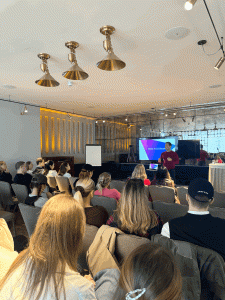
Alongside the workshops, we also had the pleasure of joining our friends at MeMo’s monthly Breakfast Talk, where Safi was invited as an expert speaker to share his knowledge on broadcast PR and how to cut through the noise and land a good story.
If you want to see an example of one of the case studies used in his exercises click here: https://www.linkedin.com/posts/safi-zisman-5aa21929_valentines-day-is-coming-and-pr-teams-activity-7419682495169884160-UFG-?utm_source=share&utm_medium=member_desktop&rcm=ACoAAAXnuRIBNiahxPl59mxQ5Kd_e8G9Maua58w
INDUSTRY NEWS
Media Act momentum: what it actually means for PRs
A cluster of Media Act updates landed this week and while it looks regulatory on the surface, there are a few signals worth clocking if you work in comms.
The headline is streaming platforms moving closer to broadcast style oversight. As the Media Act rolls out, the biggest video on demand services are being brought further into Ofcom’s orbit, particularly around audience protection and standards. It does not create full parity with traditional broadcasters overnight, but it does narrow a gap that has existed for years.
Alongside that, Ofcom has made clear this is a multi year shift, not a single policy drop. The regulator has described the Media Act as the biggest shake up of UK media rules in two decades, with phased work spanning VoD, prominence and wider broadcast standards. The key takeaway is direction of travel rather than immediate change.
The more under the radar development is radio. Ofcom is moving to reinforce requirements for locally produced local news on analogue commercial stations. It is a technical sounding update, but one with more immediate structural implications.
So what does this mean for PRs?
First, broadcast fundamentals are becoming more transferable. As major streamers edge closer to regulated environments, the relevance of broadcast discipline increases. Not because Netflix suddenly behaves like a news desk, but because editorial rigour, compliance awareness and producer first storytelling travel well across formats as standards converge.
Second, expectations around credibility are unlikely to loosen. Greater oversight does not automatically change how brands work with streamers, but regulation tends to create compliance gravity over time. As platforms sit closer to regulated media environments, the direction of travel usually favours stronger substantiation and more defensible narratives.
Third, local relevance is quietly reinforced. By pushing for locally originated news on commercial radio, Ofcom is effectively protecting regional editorial supply. For PRs, that strengthens the long term value of local angles, particularly in audio, where regional relevance is not just editorial preference but structurally supported.
This is less about immediate tactical change and more about where the industry is heading. The Media Act is regulation catching up with audience behaviour. People stopped thinking in channels years ago. Now the rulebook is starting to follow.
For PRs, the practical takeaway is simple. Broadcast logic is spreading, not shrinking. And those already fluent in that world will likely feel the shift first.
CLIENT WORK
To start off the month of February we worked with PHIN, reacting to the government’s cancer plan announcements and positioning the private sector’s role in supporting the initiative.
This was followed by Quaker and their ‘Breakfast Habits’ campaign with Olympic swimmer Duncan Scott, tackling the fact that over a quarter of Brits skip breakfast three times a week.
We also secured a ton of coverage for Lidl’s launch of their Trolley Bag, a stainless steel handbag designed by Nik Bentel that reimagines the supermarket trolley as a fashion statement, timed for London Fashion Week.
For World Encephalitis Day, we helped Encephalitis International to launch F.L.A.M.E.S., an acronym created to help the public recognize the urgent warning signs of encephalitis, featuring Dr. Ava Easton MBE, the Chief Executive of Encephalitis International.
And to end the month, we supported Snapchat’s launch of “The Keys”, an interactive online safety course for parents and teens to complete together, covering everything from cyberbullying and scams to exploitation and digital wellbeing.
The month in numbers
- 261 pieces of coverage across 5 campaigns
WHO DID BROADCAST GOOD AND WHO DID BROADCAST BAD
Swansea City and the Snoop Effect
Here’s the thing. Swansea City are sitting around 15th in the Championship. No promotion push, no relegation battle, no particularly compelling reason for a national broadcast outlet to be paying them much attention on a Tuesday night in February. And yet somehow, they ended up all over ITV News and the national press. How? One of the world’s most recognisable rappers owns a stake in the club. And when he finally showed up, they let him be exactly that.
On the 24th February, Snoop Dogg, fresh off coaching Team USA at the Winter Olympics, made his first visit to the Swansea.comStadium. And of course broadcasters ate this up. With Snoop himself requesting fans twirl co-branded towels before kick-off, the image of thousands of white towels filling the stadium as he walked the pitch went viral and became the clip every broadcaster used.
A celebrity generating media attention is hardly surprising. What deserves praise here is how they took this opportunity and worked it for everything it was worth across multiple channels and at various moments.
A training ground visit. A private performance at Welsh brand Au Vodka’s HQ in Llansamlet. Every element was a separate story, and every story was another reason for a camera to show up.
Preston manager Paul Heckingbottom then did something no PR budget can plan for. Post-match he quipped: “The only difference I noticed was the smell of weed in the tunnel.” That line travelled further than any press release.
The result of all of this? A record attendance and coverage on ITV News Wales, Sky Sports, ESPN and CNN. For a Tuesday night Championship game in February, that’s not bad.

The BBC’s BAFTA Broadcast Failure
Let’s start with the facts. On Sunday 23rd February, during the BAFTA Film Awards, a racial slur shouted by an audience member made it through the BBC’s broadcast and onto iPlayer where it sat until Monday morning. The BBC has launched an investigation. The Culture Secretary has weighed in. BAFTA has apologised.
Here’s what makes this so hard to defend – this wasn’t live television. The BAFTAs were broadcast with a two-hour delay. That window exists for one reason to catch exactly this kind of moment. And the BBC knew the stakes going in. After the Bob Vylan Glastonbury incident last summer, where they streamed a flagged “high risk” performance live and paid for it with a public apology and the resignation of their Director of Music, the BAFTAs had been specifically flagged in internal planning as an event requiring extra care.
They had the time. They had the precedent. They had the process. It still went wrong.
It’s also worth being clear about what this criticism is and isn’t. The individual in question, John Davidson, has Tourette syndrome, a neurological condition that means he had no control over what was said. This is not a story about him. It’s a story about a broadcaster that, with two hours to review the footage, chose to air it anyway. Exposing the actors on stage, the viewing public, and a man with no agency over his actions, to a very public and very avoidable moment. The BBC’s responsibility here wasn’t just editorial. It was human.
Having a crisis protocol means nothing if nobody executes it. The BBC didn’t lack awareness of the risk. It lacked the follow-through.
LOOKING AHEAD: MARCH
And just like that, we’re looking towards March.
However, there is a date worth pausing on. The 21st of March marks twenty years since Jack Dorsey sent the very first tweet: “just setting up my twttr.” Four words. A typo. And somehow, the beginning of a platform that would completely reshape how we communicate, express ourselves, engage with content and consume news.
We think it’s a perfect opportunity to look back on what those twenty years have actually done to news, to politics, to celebrity culture, to the media industry itself. Because the honest answer is: quite a lot.
And look, before we get too serious about it, it’s also worth appreciating what Twitter actually gave us. Not the algorithm. Not the ownership chaos. Not whatever it’s called now. The tweets. Specifically: Kanye asking if he could be more influential than Shakespeare. Wayne Rooney offering Rio a lift. And James Blunt, ringing in 2017 with the warning: “If you thought 2016 was bad, I’m releasing an album in 2017.”